
Seed Keeping for the African Diaspora
- Project by
- Dinah L. George
- Pronouns
- she/they

Contents
- Introduction + Reason for Project
- Understanding the African Diaspora
- Seed Keeping
- What is Seed Keeping?
- Why grow for seed?
- Why is seed keeping an act towards environmental justice?
- Keeping Your Seeds
- Choosing Your Seeds
- Growing for Seed
- Key terms for growing for seed
- A bit more on heritage seeds
- Materials, Processing, & Storage for Seeds
- Materials for Seed Keeping
- Processing Your Seeds
- Wet Processing
- Dry Processing
- Storage and Viability
- Seeds of the African Diaspora
- Okra: A Seed Story
- Okra as Heritage Seed in African Diaspora
- Characteristics of Okra & Growing for Seed
- Sea Island Red Okra
- Tomatoes: A Seed Story
- Tomatoes as a Heritage Seed in African Diaspora
- Characteristics of Tomato & Growing for Seed
- Plate de Haiti
- Okra: A Seed Story
- Resources
- Guides for Planting & Seed Saving
- Where to Get Seeds!
- Citations
Introduction + Reason for the Project
This project is part of the Black Midwest Initiative’s HUB, a central digital space that features environmental justice projects developed by BMI Fellows. The HUB curates projects for undergraduate students enrolled in environmental justice courses, as well as for public audiences seeking to deepen their understanding of environmental justice work across the Midwest and Rust Belt.
My contribution to the Black Midwest Initiative HUB is this Seed Story Guide. This guide explores the practice of growing and keeping heritage seeds from the African Diaspora. This guide centers seeds as living archives, tracing their journeys across time and place. It documents where these seeds originate, how they have been cultivated and used, and the cultural, ecological, and historical significance they hold. The guide also offers practical information, including seed and crop characteristics, growing and seed-keeping practices, and pathways for accessing heritage seeds today.
This project was developed as part of the 2025 Summer Institute on Environmental Justice, presented by the Black Midwest Initiative at the University of Illinois Chicago. The Institute convenes a cohort of BMI Fellows whose work addresses environmental justice issues impacting Black communities throughout the Midwest and Rust Belt regions. Together, these projects contribute to a growing body of knowledge that uplifts Black-led environmental justice work.
This project was truly a labor of love, and I’m deeply grateful to be part of such an incredible cohort of fellows. I hope it reaches far and wide, and that it plants seeds for future seed keepers who encounter this guide!
Understanding the African Diaspora
I can’t talk about the African Diaspora without talking about Dr. Jualynne Dodson. I first met Dr. Dodson as an undergraduate at Michigan State University after accidentally attending the wrong office hours for an anthropology course. During that first conversation, she asked me a question that shifted everything: “Where are your people from?”
At the time, the question caught me off guard. I had never been asked that before, and it felt surprisingly intimate coming from someone I had just met. I answered simply saying they were from Alabama, on both my mother’s and father’s sides, though my mother’s family largely lives in Lansing, Michigan. What I didn’t yet understand was that Dr. Dodson wasn’t asking a casual question. She was inviting me to locate myself within a much larger historical and diasporic context.
That moment changed my trajectory. Through Dr. Dodson, I became part of the African Atlantic Research Team (AART), where I encountered the African Diaspora not as an abstract concept, but as lived reality. For the first time, I saw Black people across the Americas, people who looked like my kin, in places I had never imagined. Through AART, I engaged in research, community history, and cultural study that helped me understand Black institutions I had grown up around, like the Black church, as part of a broader diasporic formation. AART planted a seed in me: research by and for people of the African Diaspora not only matters, it is necessary for our continuation as a people.. It taught me that our ancestors were waiting for us to remember.

When I returned to Dr. Dodson while developing this project and asked her to define the African Diaspora, she offered a far more precise and grounded explanation than I can replicate here. What follows is my own, admittedly less polished, attempt to carry that knowledge forward.
A diaspora, broadly speaking, is formed through the forced removal and displacement of a large population from its place of origin, often numbering in the millions, at a specific moment in time. This removal is not voluntary migration, but violent extraction: people taken from their homes, communities, and landscapes and relocated elsewhere under coercion. Over time, descendants may migrate for their own reasons, but the formation of a diaspora is rooted in this original rupture.
The African Diaspora emerged primarily through the mass kidnapping and enslavement of African peoples across the continent. In the Americas, this took shape through the Transatlantic Slave Trade. This was a global enterprise involving the forced migration of captive African people between Africa, Europe, and the Americas from the 16th through the 19th centuries (National Museum of African American History and Culture, n.d). Along the Middle Passage, Africans were subjected to extreme violence, disease, starvation, sexual assault, and death. Many did not survive the crossing; others resisted in every way they could, including jumping into the ocean to return to the earth (Battle & Sawula, 2013).
Those who survived were transported to places like the Carolinas, the Caribbean, and South America, where their labor generated immense wealth through agriculture (Battle & Sawula, 2013b). The crops produced by enslaved people were shipped to Europe and circulated through global markets, forming the economic backbone of settler colonialism and racial capitalism.
This history is foundational to this project. To be violently removed from one’s homeland, stripped of language and kinship systems and STILL LIVE?! Not only live, but be so creative in the way knowledge is passed down through something like seeds?! It’s truly awesome and worth learning.
What is less often discussed is that enslaved Africans were not taken despite their agricultural knowledge, but often because of it. People from specific regions, kingdoms, and ethnic groups were targeted for their expertise in rice cultivation, seed selection, soil management, and plant medicine. Our ancestors carried that knowledge with them and adapted it to new lands under unimaginable conditions. Neshima Vitale-Penniman articulates this powerfully in “Braiding Seeds: The Biocultural Heritages and Mobilities of Story in Black Seedkeeping Praxis,” which situates contemporary Black seed keeping within the long arc of diasporic movement, memory, and resistance.
At the heart of this guide is how people of the African Diaspora, their descendants, remained creative, resilient, and rooted in their agricultural practices. Seed keeping is where this continuum lives. Seeds carry stories, memory, and wisdom that connect us to those who came before. The seeds, and the practice of growing seeds, offers guidance for those who will come after. To keep seeds of the African Diaspora is to hold history in our hands and to choose to carry it forward.
Seed Keeping
What is Seed Keeping?
Seed keeping is the practice of growing and stewarding seeds while preserving ancestral knowledge and biodiversity. It honors the stories of those who came before us and protects the plants and crops that sustain our communities. This work stretches back millennia. On the African continent, plant domestication began over 10,000 years ago, resulting in more than two thousand native cultivars including grains, roots, vegetables, fruits, legumes, oil crops, and medicinal plants (Vitale-Penniman, 2025). The systems of settler colonialism, transatlantic slavery, and white supremacy culture have held major impacts and shifted this process for those that are present day descendants of the Diaspora (Okun, 2021).
Seed keeping is a radical act in the pursuit of food sovereignty and a practical expression of kujichagulia, self-determination. Food sovereignty is clearly defined in the Declaration of Nyéléni, developed at the 2007 World Forum for Food Sovereignty, organized by groups including La Via Campesina and Friends of the Earth International (FAO, n.d). The declaration defines food sovereignty as the right of peoples to healthy, culturally appropriate food produced through ecologically sound and sustainable methods, and the right to define their own food and agriculture systems. It centers those who produce, distribute, and consume food—rather than markets or corporations—and explicitly affirms responsibility to future generations (Declaration of Nyéléni, 2007).
I was first introduced to seed keeping through Leah Penniman’s book Farming While Black: Soul Fire Farm’s Practical Guide to Liberation on the Land, which frames the practice as far more than economic sustainability. Seed keeping is an act of sovereignty and autonomy that shifts power away from systems rooted in white supremacy and ensures agricultural heritage remains across the communities it serves. It attends to the social, cultural, economic, and ecological realities of our food systems. As Penniman writes, “In keeping the stories of our seeds alive, we keep the craft of our ancestors alive in our hearts”(Penniman, 2018, p.152).
Seed keeping is distinct from seed saving. Seed saving often focuses on biological integrity. This is important work but work that can be detached from meaning. Seed keeping, by contrast, centers story, relationship, and responsibility. It recognizes that seeds are held not only for ourselves, but for others and for future generations, just as our ancestors held seeds for us. Seed saving can also reflect a colonial framing, one that positions the grower as a “savior” of seed. Seed keeping rejects this logic. To be a seed keeper is to understand seeds as extensions of community, culture, and self. It is a practice rooted in care, reciprocity, and continuity.
For me, seed keeping is sacred work. It honors my ancestors, sustains the land, and strengthens food sovereignty. It is a practice of remembrance, healing, and responsibility, one that helps secure a future rooted in autonomy, dignity, and life.
Why grow for seed?
Seeds are the foundation of any growing practice, whether you’re tending a few containers on a balcony or farming acres of land. Keeping seeds is also a way of building knowledge, wisdom, and relationship with the plants that sustain us. For those of us in the African Diaspora, our histories are filled with moments when our autonomy has been constrained, questioned, dismissed, or violently suppressed (National Museum of African American History and Culture, (n.d.). That loss of control has touched every part of life , where we go, how we learn, how we speak, and who we are allowed to be. It has also shaped our relationships to land and seed, from the transatlantic slave trade through slavery, Jim Crow, and beyond. Keeping our seeds allows us to define, create, and speak for ourselves, making seed keeping an act of cultural memory, resistance, and self-determination.
Why is seed keeping an act towards environmental justice?
Kyle Whyte, a leading scholar in Indigenous studies and environmental justice, defines environmental injustice as “an assault on kinship relationships” (Whyte, 2020). Kinship refers to the quality of our relationships with all beings — humans, plants, animals, fish, insects, rocks, waterways, and forests. Central to kinship is reciprocity: a long-term, mutual relationship of gift-giving and care, where each relative respects both what they receive and what they are responsible to give in return (Whyte, 2020; Kimmerer, 2013).
Seed keeping is an act of environmental justice because it works to repair kinship relationships that were violently disrupted through transatlantic slavery and ongoing systems of oppression. For descendants of the African Diaspora, seed keeping reconnects us to ancestral practices of stewardship and to the stories carried by our heritage seeds. It strengthens relationships not only with the seeds themselves, but with our ancestors who tended them and with future generations who will inherit them.
Through seed keeping, we actively re-determine our relationships with food, land, and the more-than-human world. We place culturally relevant foods back at the center of our lives and reclaim agency over how we nourish ourselves and our communities. In this way, the work of rebuilding strong kinship relationships — the core of environmental justice — is embedded in the practice of seed keeping.
Simply put
If you have a reciprocal relationship with seeds,
you have a reciprocal relationship with food.
If you have a reciprocal relationship with food,
you have a reciprocal relationship with land and people.
Building strong, reciprocal relationships is the foundation of environmental justice.
Keeping Your Seeds
In this section, I bring forward important questions when choosing your seeds for seed keeping, the key terms used in language on growing for seed, and the distinction of heritage seeds in seed keeping.
Choosing Your Seeds
I hope to convince you to grow food not only for immediate nourishment, but also for the seeds you will keep for people far beyond you, across time and place! When choosing what to grow for seed, have clear answers to the following:
Who are you growing these seeds for (past, present, and future)?
Seed keeping asks us to think hard about the “who” we grow and keep seed for. The “who” may include people you know like family, friends, and other parts of your community. It also extends to the broader relationships you hold with your environment. Here in the Midwest native plants support rich biodiversity, from small mammals to insects like monarchs and swallowtails, to the many birds who share this region. Keeping seeds allows us to think beyond immediate food and toward supporting whole ecosystems.

What type(s) of crops do you actually like AND plan to grow in future seasons?
If we’re going to be in anything in life, we have to be forreal! Be honest about what you truly enjoy growing and eating. This might be as simple as an herb you love (mine is cinnamon basil), a perennial flower, or a variety bred for specific conditions, like Doc’s North Carolina Roselle (Truelove Seeds, n.d-a). You can also grow and keep seeds for others, sharing varieties loved by your community. You just have to be clear about which seeds you are committing to steward.
Seed keeping is a long game. It’s not just about this year’s harvest. It’s a process of selection over many seasons. Whether you aim to keep seeds true-to-type (see Plant Breeding section) or to develop varieties adapted to your tastes, climate, and community, you’ll be working with these seeds for years.
How much space do you need for what you’re trying to do?
Different crops require different amounts of space, and seed crops often require even more distance for proper isolation. To keep seeds with the traits you want, you must account not only for growing the crop itself, but also for preventing unwanted cross-pollination. Limited space can make isolation more challenging, so careful planning is key.
How much money can you invest in keeping your seeds? If funds are limited, what resources can you connect with?
Seed keeping is an investment, both in money and sweat equity. You’ll need supplies to grow, harvest, process, and store seeds so they remain viable. The good news is that seed keeping can be as small- or large-scale as you choose.For home gardeners, this might mean building simple tools and using reusable materials. For community gardens or farms that support livelihoods, it’s important to plan for the real costs of supplies, labor, and storage. Seed keeping connects you to a wider community, and many groups share resources and knowledge. See the processing and storage section for materials you may need, and include these costs in your annual garden or farm plan. You can also tap into collectives of seed keepers and seed savers to help you with.
How do you plan to share or disperse the seeds you keep?
Seed keeping is a collective practice. Seeds are meant to be shared. As a seed keeper, you are also a keeper of stories, of where seeds come from and how they are cared for. Have a plan for where and with whom you will share seeds. You might join seed-saving groups, attend seed swaps, connect with organizations like the Utopian Seed Project or Ujaama Cooperative Farming Alliance, participate in conferences, contribute to a seed library, and/or donate to seed banks at libraries and schools. You might also start a seed circle in your own community. How you do is up to you, but you need to find a way to share the seeds you’ve grown. Sharing seeds encourages care and accountability. When you know seeds will be passed on, you’re more likely to steward them well and share varieties that support the health and success of other growers.
What is your climate and environment like for growing?
Understanding your growing environment is essential. In the United States, USDA Plant Hardiness Zones help determine which plants are suited to your climate (USDA, 2023). Each place comes with different insect pressures, wildlife, community dynamics, wind exposure, and rainfall patterns. Growing for seed means growing in relationship with place. The more you understand your environment, the better you can steward seeds that belong.
How much environmental harm has been done to your area?
Consider whether your soil, air, or water have been impacted by pollution, as this can affect plant health and seed quality. Think about whether you are growing in an urban, rural, or suburban setting. This requires soil testing for containments and getting a gauge on the nutrient levels in your soil. Your local extension office can help you find the proper resources.
Growing for Seed
Seed keeping is a powerful practice, but learning how to grow specifically for seed can feel overwhelming. This section introduces basic concepts and key terms to support your learning. More resources are listed at the end of this guide and you’re encouraged to keep exploring on your own. Fair warning: these terms can lead you down a deep research rabbit hole!
Key Terms
Heirloom Seeds
In seed saving and production, heirloom refers to traditional varieties passed down through generations rather than developed by modern commercial breeders. These varieties generally originated before the 1940s (Barth, 2016). Heirloom seeds are open-pollinated, shared in the legal “commons,” and are not patented — unlike many modern corporate-bred seeds.
Heritage Seeds
In seed saving and production, heirloom refers to traditional varieties passed down through generations rather than developed by modern commercial breeders. These varieties generally originated before the 1940s (Barth, 2016). Heirloom seeds are open-pollinated, shared in the legal “commons,” and are not patented — unlike many modern corporate-bred seeds.
While heirloom seeds describe age and lineage, heritage seeds carry cultural memory. These are seeds passed through generations within specific communities, especially in the African Diaspora, where seeds hold stories of migration, resistance, survival, and creativity. Heritage seeds connect seed keeping with active remembrance, storytelling, and ancestral knowledge.
Genetically Modified Organism (GMO) Seeds
These are seeds engineered in laboratories for specific industrial agriculture traits (Barth, 2016). They are typically protected by patents, meaning farmers cannot legally save and replant them and must purchase new seed each year. Common GMO crops include corn, soybeans, cotton, canola, papaya, certain potatoes and apples, and alfalfa for animal feed (Belle & Starr, 2020).
Many food sovereignty movements critique GMOs because seed patents restrict farmers’ autonomy and control over their seed. This concern is reflected in the 2007 Declaration of Nyéléni, where 500 delegates from across the globe gathered in Mali to affirm food sovereignty as a political, ecological, social, and economic right. The declaration explicitly challenges GMOs for undermining the ability of farmers and communities to exercise control over their food systems and seed (Nyéléni, 2007).
True to Type Seeds
True-to-type seeds produce plants that closely resemble the parent in traits like fruit, color, vigor, and growth habit. These are typically open-pollinated, non-GMO seeds and are the foundation of seed saving (Barth, 2016; Holmes Seed Company). A simple way to think of it: what you see is close to what you get.
F1-Hybrid Seeds
F1 hybrids are the first-generation offspring of two intentionally crossed parent varieties. They are valued for uniform size, appearance, and yield (Barth, 2016; Holmes Seed Company). However, seeds saved from F1 plants (F2 generation) do not reliably reproduce the same traits. Because they are not true-to-type, F1 hybrids are not ideal for long-term seed keeping.
Open Pollinated (OP) Seeds
Open-pollinated varieties are pollinated by wind, insects, or self-pollination rather than controlled breeding. Seeds from OP plants can be saved year after year because they grow true-to-type (Barth, 2016; Holmes Seed Company). OP seeds are essential for biodiversity and resilient food systems.
Cross Pollination
Cross-pollination happens when pollen from one plant fertilizes another plant of the same species (University of Minnesota Graduate School, 2019). Many seed keepers worry about it, but it is not inherently negative. When done intentionally, cross-pollination can increase genetic diversity and lead to resilient new varieties.
The key is understanding when you want to prevent crossing and when you want to encourage it. Mama Bonneta Adeeb of the Ujaama Cooperative Farming Alliance shared that gem at the 2025 Black Farmers and Urban Growers (BUGS) conference in Detroit. She spoke about the Heirloom Collard Project. This project grew rare collard varieties together, resulting in the “Ultra Cross” collard — a variety with tremendous genetic diversity created through cross-pollination. Because the plants were the same species, this crossing strengthened the seed, carrying forward both biological diversity and the stories of many growers (Janson & Seed Savers Exchange, 2017). Like anything meaningful, cross-pollination must be understood and used with purpose in your seed-keeping practice.
Isolation Distance
Isolation distance is the space needed between varieties of the same species to prevent unwanted cross-pollination and maintain true-to-type seed. The required distance varies by crop and growing conditions, but in general, more space means more control (Seed Savers Exchange, 2025).
Plant breeding
Plant breeding is the ancient practice of selecting and crossing plants for desirable traits (Goldman Lab ,n.d). While large corporations focus on profit-driven breeding of major commodity crops, community seed keepers also act as plant breeders by selecting seeds that preserve cultural significance, flavor, resilience, and regional adaptation. Greater crop diversity strengthens both ecosystems and food systems.
Varieties & Cultivars
A variety occurs naturally in nature where there is variation within a species and usually grows true-to-type from kept seed. A cultivar is developed through human intervention for specific traits and often does not reproduce consistently from kept seed. Many seed keepers prioritize varieties for long-term stewardship (R/plantbreeding on reddit, 2021).
Annuals
Annual plants complete their life cycle, from seed to seed, in one growing season (VanDerZanden, 2008). Climate can affect classification; for example, roselle is perennial in tropical regions but is considered an annual in Michigan due to colder winters.
Perennials
Perennials live for more than two years. Herbaceous perennials (trees and shrubs included) die back to the ground each winter and regrow in spring, while woody perennials (trees and shrubs) maintain above-ground stems year-round (VanDerZanden, 2008).
USDA Plant Hardiness Zones: The USDA divides the U.S. and Puerto Rico into climate zones based on average minimum winter temperatures. These zones help growers understand which plants are likely to survive in their region. Much of Michigan has recently shifted from Zone 5 to Zone 6, reflecting warming trends (Masterclass, 2021).
Days to Maturity
Usually listed on seed packets, this refers to the average number of days from transplanting (or direct sowing) to harvest. It helps growers plan timing and understand when a crop will reach its desired stage (Barth, 2016).
Season Extension Techniques
Anything a grower uses to lengthen the growing season, especially necessary in colder climates. Methods include starting seeds indoors, cold frames, hoop houses, greenhouses, and timing strategies like cold stratification. This is especially important in regions with short growing seasons, like the Midwest.
A Bit More on Heritage Seeds
“History explores and explains pasts grown ever more opaque over time; heritage clarifies pasts so as to define them with present purposes”
(Fennel, 2024 as cited in Lowenthal)
Heirloom seeds describe age and generational passing. Heritage seeds, as used in this guide, go further. They center memory, story, and cultural meaning within African Diasporic communities. A seed may be biologically heirloom, but it becomes heritage through lived history. For example, the tomato variety Plate de Haiti is not only valued for its growth habit and flavor, but for its connection to movement, resistance, and survival following the Haitian Revolution. These seeds carry the memory of people who protected life under systems meant to destroy it. I’ll be speaking about this seed later on in the Seed Stories Section.
When we grow heritage seeds, we participate in a continuum of remembrance. We honor those who came before us, the knowledge they carried, and the futures they made possible. Heritage seeds hold not just genetics, but story, resilience, and ancestral wisdom.
Materials, Processing & Storage for Seeds
This section covers the ways 3 Sistas Farm Collective prepared supplies for seed keeping for this upcoming season and guides from the Southern Exposure Seed Exchange (Southern Exposure Seed Exchange, n.d). These are low-cost means of knowing what you need for successful seed viability (longterm ongoing living of the seed) that the people in our collective have talked about, gathered, and used for our seed keeping this year. Additional information found in the Resources section!
Materials for Seed Keeping
This list focuses on small-scale seed keeping for at home gardeners and small acre farm operations. Larger operations may need professional equipment not listed.
- Containers: Use airtight containers made of glass or plastic. Plastic (like takeout containers) is affordable and easy to find, while glass is more durable, reusable, and less toxic. Jars, buckets, or reused food containers all work, just make sure the lids seal tightly.
- Seed Packets: Packets help organize and portion seeds. You can make your own with paper envelopes or buy blank packets. Even when using packets, store them inside airtight containers to protect seeds from moisture, sunlight, and humidity.
- Dry Processing Tools: Large kitchen sifters and bowls, screens, and a fan (for winnowing). Gloves and your own hands are often your most important tools for breaking open pods and removing seeds.
- Wet Processing Tools: Access to water, jars or buckets, strainers or screens, gloves, and open workspace.
- Flat Surfaces: Tables, counters, trays, or boards are needed for drying seeds. Always spread seeds in a single layer for good airflow.
- Towels & Plates: Ceramic or paper plates and clean towels work well for drying seeds. Avoid styrofoam when possible due to toxins and waste.
- Cutting & Scooping Tools: Scissors, knives, and spoons help open pods and scoop seeds from fruits. Keep tools clean and sanitized.
- Labeling Supplies: Permanent markers, tape, pens, or a label maker are essential. Include variety name, year saved, and any breeding notes like germination rate or days to maturity.
- Freezer or Refrigerator: Cool, dark storage extends seed life. A dedicated fridge or freezer is ideal, but careful shared use can work. Cold storage can extend viability beyond the typical 2-year window to 2-4 years.
- Drying Racks: Racks allow you to dry more seeds at once. You can build, repurpose, or buy them. Add mesh or screen material so seeds don’t fall through.
Processing Your Seeds
After growing crops for seed, the next step is processing! This is where you clean and prepare seeds for storage. There are two main methods: wet processing and dry processing. Wet processing is used for seeds inside fleshy fruits like tomatoes, cucumbers, squash, melons, and eggplant. These crops encased inside of a fruit or vegetable that would have juicy, pulpy “wet” casing. Dry processing is for seeds that dry naturally in pods or seed heads. It includes things like beans, lettuce, peas, brassicas, herbs, and many flowers. Peppers can go through both a wet and dry processing procedure. When dry processing, I look for a “crunchy” texture and sound. I recommend you research the best way to process seeds for the vanities you’re growing. All this information can be found here from Seed Savers Exchange (SeedSavers Exchange, 2025b).
Both methods follow four basic steps.
Wet Processing
- Harvest: Pick when ripe for eating, or allow fruit to overripe on the plant until soft, brown. My co-founder of 3Sistas and friend Hillary likes to say when it becomes “a little yucky.”
- Dislodging seed: This part requires getting the seeds out of the fruit. Cut or break fruit open and scoop out seeds. Clean tools before and after use.
- Separating viable seed from plant material: Methods include soaking, fermenting (commonly for tomatoes and cucumbers), and decanting.
- Soaking involves placing the pulpy seed mass in water for 4–12 hours in a cool, dark place to loosen plant material — this works well for crops like melons and squash.
- Fermenting means letting seeds sit in their juices for 1–3 days to break down the gelatinous coating around them, stirring occasionally and keeping them out of direct sunlight.
- Decanting involves adding water and pouring off pulp and floating debris; mature, viable seeds usually sink while immature seeds float. This step is most useful for seeds that sink, like tomatoes, and less helpful for seeds that naturally float, like some cucumbers, eggplants, and squash. After any of these methods, rinse seeds thoroughly through a strainer or screen to remove remaining plant material.
- Drying: Spread seeds in a single layer in a cool, dark, well-ventilated space. Seeds are dry when they snap rather than bend.
Dry Processing
- Harvest: Collect pods, seed heads, or entire plants when seeds are mature and as dry as possible. For things like okra, you’ll harvest seed pods but for flowers, harvest the head (where the flower/ petal parts are).
- Dry: Lay them out on screens or hang in mesh bags in a cool, dry place. Make sure the seeds have good airflow and keep them safe from moisture or pests.
- Dislodge (Thresh): This is separating your seeds from the fruit of the harvested plant. Break open pods or rub seed heads to release seeds using hands or gentle force. This can occur by beating, flailing, treading on, rubbing, or shaking the plants. Apply force and friction to extract the seeds. You can wear kitchen safe gloves or be bare handed for this.
- Separate: Separating seeds from plant material typically involves screening and winnowing. Screening uses tools like colanders, hardware cloth, or mesh screens to remove large debris or sort seeds by size. Winnowing uses air movement — wind, a fan, or gently blowing across a bowl of seeds — to lift away lighter chaff while heavier, viable seeds remain. Even a simple motion like lightly tossing seeds in a bowl and blowing across the top can help separate out unwanted material.
Wet processing goes more in depth in this video on tomato processing with Alan, greenhouse manager at Seed Savers Exchange here (Seed Savers Exchange Heritage Farm, & Kissinger, A., 2023).
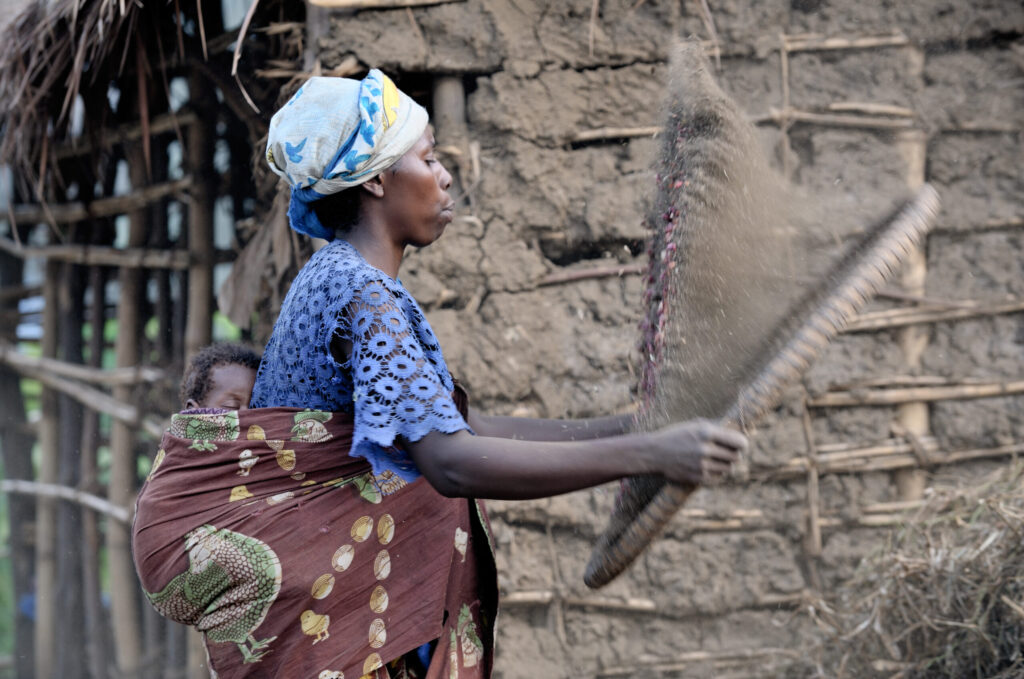
Dry Processing is outlined in this video on okra seed saving with Theresa, narrator for a series done for the Utopian Seed Project here (Smith, C., Kadish, T., Blackwood, R., & Utopian Seed Project, 2023).
Storage & Viability
Proper storage is key to a strong seed-keeping practice. Once fully dried, store seeds in airtight containers in a cool, dark place like a cupboard, pantry, shed, or fridge. Protect seeds from light, heat, and humidity, which reduces viability. Viability refers to how long seeds are able to germinate. Many seeds last about two years at room temperature, but cold storage can extend their life. Stay organized, label clearly, and create a system that makes seeds easy to find and use in future seasons.
Seeds of the African Diaspora
For those who are engaged in, or moving toward, seed keeping, crops and seeds become a way to connect with the African Diaspora across time and place. Seeds braided into the hair of those forcibly taken from their homes and carried through the Middle Passage (Penniman, 2018,pp.149), seeds shared across communities, and seeds adapted and adopted in the Americas all exist within this living continuum.
When thinking about the specific crops and seeds of the Diaspora, Amirah Mitchell, founder of the Black diasporic seed company Sistah Seeds, has created space for many of us to reconnect with ancestral seeds and continue the stewardship from those who came before us. I have relied on her seed catalog, along with the African Diaspora Collection from True Love Seeds and the Ujaama Seeds catalogue, to better understand the species and varieties present across the contemporary Diaspora, particularly in the Americas (Sistah Seeds, n.d.) (TrueLove Seeds, n.d.-b) (Ujaama Seeds, n.d.). As a beginning seed keeper, understanding Diasporic seeds felt challenging. These curated catalogs became an entry point for learning the histories and cultural significance of many crops, especially those I did not grow up eating, and for understanding them as heritage seeds rather than simply food crops.
Seed Crops Found in the African Diaspora
(Seeds from the catalogs referenced above)
- Poaceae (Grains): Sorghum, rice, millet
- Amaranthaceae (Amaranth): Amaranth varieties and callaloo (edible amaranth leaves)
- Brassicaceae (Brassicas): Mustard greens, collards, kale, lettuce, turnips, beets
- Solanaceae (Nightshade): Tomatoes, eggplants, and peppers (sweet, hot, and seasoning varieties)
- Malvaceae (Mallow): Okra, cotton, roselle (hibiscus)
- Leguminosae (Fabaceae): Beans and legumes, including African peas known as southern peas, cowpeas, field peas, crowder peas, and black-eyed peas
- Cucurbitaceae (Cucurbits): Squash, pumpkins, watermelon, cantaloupe, cucumbers
In the last part of this guide I highlight two seeds through what I call “seed stories”. In this you will learn about the seeds of okra and tomato and how they’ve developed my own journey as a seed keeper and environmental justice practitioner.
Okra: A Seed Story
Okra is one of my favorite crops to grow. The first time I tasted it, I was a child visiting family in the South. During one of our trips to rural Alabama to visit my Dad’s side of the family, my aunt prepared a meal that included something I had never tasted before. I remember loving it immediately. Later, my mom told me it was okra. I couldn’t describe the flavor or texture now, I just remember thinking, “this is really good, why don’t we eat this at home more?”
The truth was that neither of my parents cared much for okra, so it rarely showed up on our plates Oh, but me? Yeah, okra was going to become a staple. Years later, I look for it in seed catalogues and always order it when I go out. I’m not the best at cooking it but I’ve been practicing and it’s getting better!
The first time I saw okra growing as a crop was years later at D-Town Farm, the urban farm of the Detroit Black Food Sovereignty Network. I had just arrived in Southeast Michigan as an intern and, fresh off my AmeriCorps service at Hunter Park GardenHouse in Lansing, I thought I knew a thing or two about farming. D-Town quickly humbled me. One day, we were assigned to harvest the last of the summer okra, and I saw it in full form: tall plants in long rows, crowned with striking flowers. I assumed they were hibiscus until the farm manager said, “Oh, that’s okra.”
That moment stayed with me. Since then, okra and its many heritage varieties have held a special place in my heart. Okra is beautiful, resilient, drought-tolerant, and generous. It’s an ideal plant for growers with limited resources and a staple that fits into countless dishes. Growing okra reflects my own journey of rediscovering foods of the African Diaspora and connecting to them through lived, practiced relationships. I love okra deeply, and I hope that comes through in this story.
Okra as a Heritage Seed in the African Diaspora
Okra originates in Northeast Africa, in present-day Ethiopia, with records of cultivation in ancient Egypt dating back over 3,000 years. From there, it spread throughout Africa, the Middle East, and Asia (Charbonneau, 2019). The word “okra” is derived from the word “nkru”, a word from the Ashanti people of West Africa. Okra’s entered the foodscape of the Americas in the 17th century through the Transatlantic Slave Trade. Like other diasporic seeds, including black-eyed peas, African rice, and sorghum, okra seeds were carried across the Middle Passage, often braided into the hair of enslaved Africans (Vitale-Penniman, 2025). These seeds traveled throughout the Americas, including the Carolinas, the Caribbean, and South America, and continued to spread as African descendants moved and rooted themselves in new places across our diaspora.
Okra is deeply embedded in diasporic foodways, most notably in Southern gumbo — a slow-cooked stew that relies on okra as a thickening agent. The word “gumbo” comes from the West African term “ngombo” (Southern Exposure Seed Exchange, 2026). Variations of okra-based stews appear across the Americas; in Cuba, for example, “quimbombó” refers both to okra and in dishes that use it in forms of African diasporic stews (The Sofrito Project, 2020).
Characteristics of Okra & Growing for Seed
Okra belongs to the mallow family (Malvaceae), genus Abelmoschus, species Abelmoschus esculentus (United State Department of Agriculture, n.d). While it is most commonly grown for its oblong seed pods, the leaves and flowers are also edible. Pods are best eaten when they reach 2–4 inches in length and are tender; depending on the variety, pods may be long and slender or short and stout. Okra prefers a balanced loamy soil, being planted in warm soils of at least 65 degrees.
The ridges along the pod are often called “spines,” though many varieties, such as the popular Clemson Spineless, are bred to reduce this trait (Truelove Seeds, n.d-c). Okra plants do require space: they can grow up to 7 feet tall and should be spaced accordingly. Smaller varieties, such as Alabama Red, are better suited for home gardens (TrueLove Seeds, n.d.-c).(Ujaama Seeds, n.d-a).
Allow the pods to remain on the plant well past the eating stage until they become long, brown, woody, and when you can hear the seeds rattle inside. Harvest the pods with garden snipes and allow them to dry further in a warm, dry place. Once fully dry, remove the seeds and use wind, breath, or a fan to separate seeds from chaff using dry processing methods described earlier (TrueLove Seeds, n.d.-c).
Seed Highlight: Sea Island Red Okra
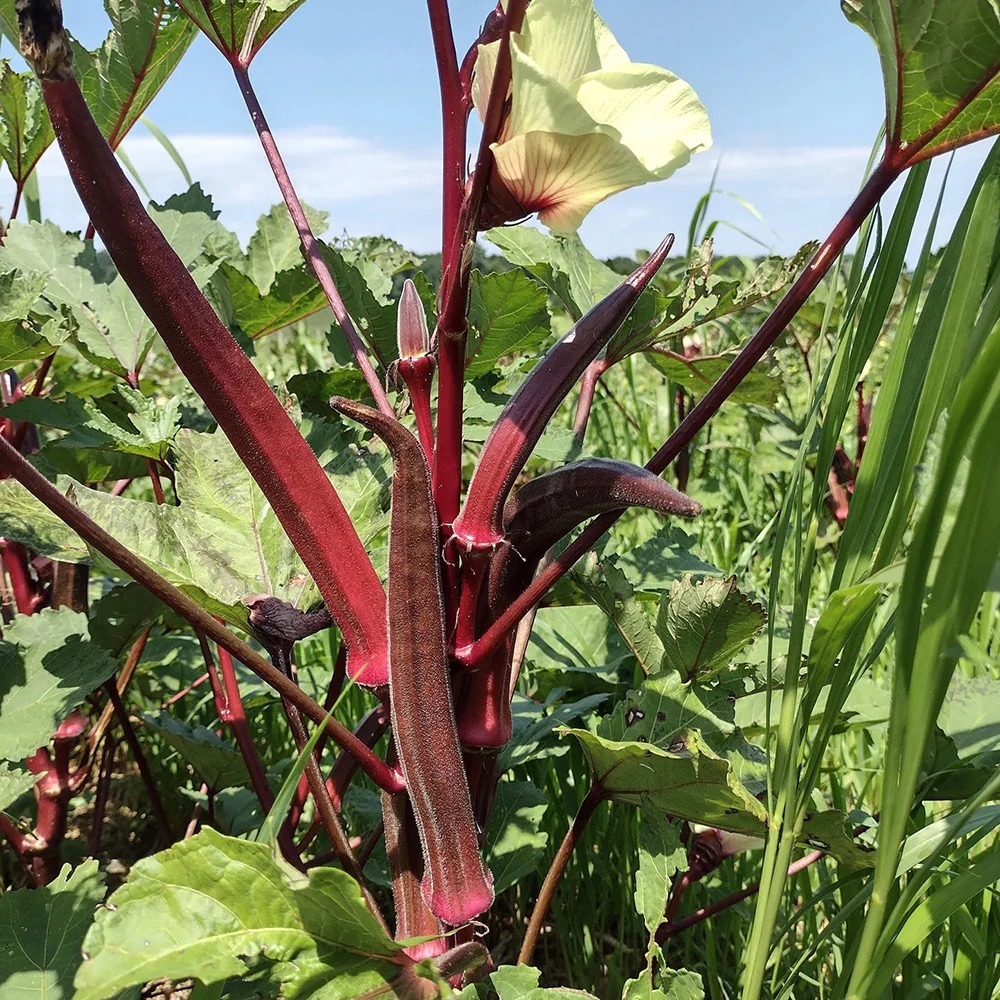
One of the varieties that’s been growing within the farm collective I am a founding member 3 Sistas, is the Sea Island Red Okra. This seed comes from the Gullah-Geechee people on the coastal lines of the Carolina, Georgia, and some parts of Florida. The folks all these lands are experts in African diasporic crops and of the cultures and communities within the United States, have some of the most direct linkages to practices found in communities and tribes along the coast of West Africa. These seeds are a living link of what our ancestors were able to steward in the Americas through and past the transatlantic slave trade. It’s this stunning red pod that when cooked goes back to being green (Ujamma Seeds, n.d-b) You can eat it raw and it’s recommended to harvest it at about 2-4 inches (think the length of your middle finger).
Tomatoes: A Seed Story
Fun fact about me: I don’t really like eating tomatoes. I haven’t since I was a kid. I’ve adapted over time. If they’re cooked down, blended, or tucked into a dish, I’m in. But if you hand me a raw tomato and say, “Here, Dinah, eat this,” the answer is a firm no. That said, I love growing tomatoes. I find them fascinating, even if they can be a pain to trellis. Part of my work is on access, and tomatoes are often one of the easiest entry points for people interested in agriculture and food systems. My friend Lauryn laughs because I’m constantly coming up with tomato-based dishes for others to try, fully aware that I’ll probably decline to eat them myself. Still, my love for tomatoes runs deep. Who knows, give it a few more years and I might become a tomato convert.
Tomatoes also hold a deeper importance for me because they were my entry point into food justice. I was first introduced to food systems work through Dara Cooper’s talk “Black Feminist Freedom Dreams: Food Sovereignty and the Urgency of Intersectional Movement Building” (Cooper, 2019). In that talk, she introduces the concept of food apartheid, which she defines as “the systematic destruction of Black self-determination over food — through land and resource theft, discriminatory policies, predatory marketing, and corporate control — resulting in devastating health outcomes for Black communities” (Cooper, 2017). Unlike the term “food desert,” food apartheid names the structural and racialized roots of these inequities.
While researching food apartheid for a course I taught through Oberlin College’s Mellon Food Justice Grant, I encountered the work of farmer and activist Karen Washington. In her piece “It’s Not a Food Desert, It’s Food Apartheid,” she speaks directly on, you guessed it, tomatoes!!! Specifically, how the simple act of tasting a fresh tomato made clear how deeply disrupted her relationship with food had been. Her questioning of why access to healthy, meaningful food had been deliberately denied, and why she had to rebuild that relationship herself, captures the heart of environmental and food justice. Tomatoes spark so much for me because they hold layered meanings within the African Diaspora. They are not just crops, but mirrors of history, access, loss, and reclamation. In this way, tomatoes, like many heritage crops, reveal how deep this food and seed stuff really gets!
Tomatoes as Heritage Seed in African Diaspora
Tomatoes are not native to the African continent. They originate in Central and South America, where they first grew wild in the Andean Mountains before being cultivated by Indigenous civilizations in present-day Mexico, including the Maya and Aztec peoples (Dinhut, 2024). Like many crops, tomatoes were later redistributed through European colonial expansion and the transatlantic slave trade, which introduced them to Africa and, by extension, to enslaved Africans and their descendants throughout the diaspora (Twitty, 2024).
Early European encounters with tomatoes were marked by suspicion. Because tomatoes resemble other nightshade plants, which were known to be poisonous, they were initially avoided in European diets (Dinhut, 2024). This shifted as people of the African Diaspora, particularly our cousins in the Caribbean, began incorporating tomatoes into their cooking, transforming the crop into a staple through diasporic foodways (Loghouse Plants & Lambi Fund of Haiti, n.d.). Over time, tomatoes were further adapted by settler colonists and became embedded in regional cuisines, taking on a long and distinct history. My own introduction to heirloom seeds started with heirloom tomatoes!
Although not native to Africa, tomatoes are now deeply woven into diasporic cuisines across the globe. They appear in countless dishes, including jollof rice (I’ll stay in my Black U.S. American lane and let my Nigerian and Ghanaian cousins debate that one), Southern stewed okra and tomatoes, Creole classics like sòs vyann, some versions of Hoppin John, and even Black American spaghetti — if you know, you know!
Characteristics of Tomato & Growing for Seed
Tomatoes belong to the nightshade family (Solanaceae), genus Solanum, species Solanum lycopersicum (United States Department of Agriculture, n.d.-a). Among crops found across the African Diaspora, tomatoes are some of the most phenotypically diverse. They range in color from yellow and bright vermillion red to deep purples that appear almost black, and in size from tiny, spoon-sized fruits to large slicing tomatoes that can fill your palm (Mary’s Heirloom Seeds, n.d).
Because tomatoes are so diverse and widely grown, this section focuses on varieties outlined in Southern Exposure Seed Exchange’s tomato growing guide. I encourage you to explore further, as tomatoes are one of the most popular crops globally, both within and beyond the African Diaspora.
One of the most important distinctions when growing tomatoes for seed is whether a variety is determinate or indeterminate. Determinate tomatoes are compact, produce most of their fruit at once, and may not require staking, though yields improve with support. Indeterminate tomatoes are vining plants that continue producing fruit throughout the season. Some varieties fall in between and are considered semi-determinate (Southern Exposure Seed Exchange, 2023). Regardless of type, I recommend trellising tomatoes no matter what. Trellising simply means providing a support structure that allows plants to grow upward, improving airflow and reducing disease. Determinate tomatoes will stop producing after reaching a certain point, while indeterminate varieties will keep going until frost or increased pest pressure. Spacing is also critical. Southern Exposure Seed Exchange recommends spacing tomato plants about 24 inches apart. If planted closer, diligent pruning and monitoring are essential to prevent disease and manage pests.
When growing tomatoes for seed, select fruits from the healthiest, most productive plants, those that best express the traits you want to carry forward. To ensure seeds grow true-to-type, make sure to do your research and consult others in your community. Tomatoes can be harvested for seed once fully ripe and ready to eat!
Common tomato types include:
- Saucing or paste tomatoes (used for sauces, salsas, and paste)
- Slicer tomatoes (large heirlooms for sandwiches and fresh eating)
- Snacking tomatoes (cherry and small varieties for salads and eating fresh)
- Winter storage tomatoes (long-keeping varieties with milder flavor)
Additional guidance on greenhouse tomatoes and common tomato diseases can be found in Southern Exposure Seed Exchange’s growing guide listed in the resources section of this booklet.
Seed Spotlight: Plate de Haiti

I chose to include this spotlight specifically because discovering Plate de Haiti was a moment of real excitement for me. Outside of the familiar Amish Paste tomato, I hadn’t encountered many heritage saucing tomatoes with such a rich history. Plate de Haiti carries both culinary value and deep diasporic meaning.
This tomato traces its name and legacy to Haiti, the first and only free Black Republic. The seeds were stewarded and shared by food historian Dr. William Woys Weaver, who received them from Dr. Carolyn Male in the United States. Dr. Male obtained the seeds from the late Norbert Parreira of Hellemmes, France, who collected them from Haiti. Through Weaver’s efforts, these seeds were reintroduced into circulation, making it possible for growers like me to cultivate them today (Loghouse Plants & Lambi Fund of Haiti, n.d.).
Historically, European colonists long considered tomatoes poisonous due to their resemblance to other nightshades. However, African and African-descended peoples, drawing on deep agricultural knowledge, incorporated tomatoes into their cooking traditions. Over time, these foodways influenced colonial diets as well (Dinhut, 2024). In the case of Plate de Haiti, the seeds are believed to have reached Philadelphia following the Haitian Revolution of the 1790s, when French Creole families and people of color fled Haiti and brought seeds and food traditions with them (Loghouse Plants & Lambi Fund of Haiti, n.d.). This tomato entered new culinary landscapes and stands as a powerful example of how African diasporic movement shaped food systems, even for a crop as globally significant as the tomato.
Closing
I want to offer a moment of acknowledgement with all that’s happening in the Midwest. From ICE occupations, to the many people who have put their lives on the line, to those that have lost their lives to occupations, and the continued occupation of George Floyd Square. Environmental justice is especially important to hold at the forefront. The Midwest, and especially the African Diaspora within it, is held together by deeply resilient people who have long carried and continue to carry the work of justice, care, and sovereignty. While this guide focuses on seeds in a literal sense, it also speaks to seeds of resistance, creativity, and collective survival. My ultimate goal with the Cowrie Acres Farm Project, and now with the 3 Sistas Farm Collective, is to practice autonomy in tangible ways, to make self-determination something lived, shared, and actionable. This guide is one offering toward that vision. There are many seeds I did not cover here, but they will appear in future iterations of this work.
Thank you for reading and if something here resonated with you or sparked curiosity, feel free to reach out at dgeorge@cowrie-acres.com! I love to talk and I LOVEEEEE to talk about seeds.
Resources
Guides for Planting & Seed Keeping
Here are some great resources for seed keeping! Just know that many people refer to things as seed saving but you can easily translate that to the practical work of seed keeping!
- Holmes Seed Company. Seed saving: Crossing, hybrids, true-to-type. Holmes Seed Company. (n.d.). https://www.holmesseed.com/growers-guidebook/frequently-asked-questions-faq/seed-saving-crossing-hybrids-true-to-type
- Holmes Seed Company. (n.d.-a). Growers guidebook. https://www.holmesseed.com/growers-guidebook
- MacKenzie, J., & Grabowski, M. (n.d.). Saving vegetable seeds. UMN Extension. https://extension.umn.edu/planting-and-growing-guides/saving-vegetable-seeds
- Marion, L. (2017a, March 5). The difference in types of seeds: GMO, Hybrid & Heirloom. MIgardener. https://migardener.com/blogs/blog/the-difference-between-gmo-hybrid-organic-and-heirloom-seeds
- MSU Extension. Vegetable gardening. MSU Extension: Gardening in Michigan. (n.d.). https://www.canr.msu.edu/home_gardening/vegetables
- Porter, J. (n.d.). Hybrids & Heirlooms | Illinois Extension. https://extension.illinois.edu/sites/default/files/dkk-mg-seed-swap-hybrid-heirloom.pdf
- South Dakota State University Extension. (2025, June 23). Saving seed: Will the seed produce plants similar to the plant it was collected from?. Saving Seed: Will the seed produce plants similar to the plant it was collected from? https://extension.sdstate.edu/saving-seed-will-seed-produce-plants-similar-plant-it-was-collected
- Southern Exposure Seed Exchange. (n.d.). Growing Guides. Southern Exposure Seed Exchange: Growing Guides. https://www.southernexposure.com/growing-guides
- Southern Exposure Seed Exchange. (n.d.). Okra Growing Guide. Southern Exposure Seed Exchange: Okra Growing Guide. https://www.southernexposure.com/okra-growing-guide
- Southern Exposure Seed Exchange. (n.d.-b). Roselle culture Hibiscus Sabdariffa. Growing Guide Roselle Culture Hibiscus sabdariffa: Southern Exposure Seed Exchange. https://www.southernexposure.com/growing-guides/rFaoselle-culture.pdf
- Seed Savers Exchange Heritage Farm, & Kissinger, A. (2023, October 26c). How to save tomato seeds. Seed Savers Exchange. https://www.youtube.com/watch?v=wEFwbnnZvBc
- Smith, C., Kadish, T., Blackwood, R., & Utopian Seed Project. (2023, February 6). How to Save Okra Seeds. Utopian Seed Project. https://www.youtube.com/watch?v=fd6DWHkXJSQ
- Smith, C., Kadish, T., Blackwood, R., & Utopian Seed Project. (n.d.). Southeast Seed Video series. Utopian Seed Project. https://www.utopianseed.org/southeast-seed-video-series
- Taylor, O., & Bolden-Newsome, C. (n.d.). Seeds and their people radio show. Truelove Seeds. https://trueloveseeds.com/blogs/satpradio
- Ujamaa Cooperative Farming Alliance. (n.d.). Seed Farming Videos. Ujamaa Cooperative Seed Farming Alliance: Ujamaa Cooperative Farming Alliance. https://ujamaafarms.com/seed-farming-videos
- University of Illinois-Urbana Champaign https://extension.illinois.edu/news-releases/grow-confidence-when-choosing-seed-packets-your-garden
Where to get seeds!
This is the fun part, here are some places you can get seeds and support regional seed keepers and seed savers!
- Seed Savers Exchange
- Alliance of Native Seed Keepers
- Ujamaa Seeds
- Sistah Seeds
- Truelove Seeds
- Utopian Seed Project
- Dollar Seed Co.
- Southern Exposure Seed Exchange
- Dollar Tree (I know, surprising, but they have some solid heirloom seeds!)
Figures
- Figure 1: Battle, M., & Sawula, C. (2013). The Trans-Atlantic Slave Trade: African Passages, Lowcountry Adaptations. Lowcountry Digital History Initiative. https://ldhi.library.cofc.edu/exhibits/show/africanpassageslowcountryadapt/introductionatlanticworld/trans_atlantic_slave_trade
- Figure 2: Frog Song Organics [@FrogSongOrganics]. (2024, June 3). Photo or post from Frog Song Organics Facebook page [Photograph]. Facebook. https://www.facebook.com/FrogSongOrganics/posts/pfbid02vbB4RwtveqdwEdz6PaFHEoA8j2urC9fSLopNLNwFHfwnCg5qc9o2Lf3HF71phZPRl
- Figure 3: Heirloom Collards Project. (n.d.). The collards. https://heirloomcollards.org/the-collards
- Figure 4: Kairos Photos. (n.d.). Winnowing: What it is and how to do it. https://www.kairosphotos.com/blog/winnowing
- Figure 5: Ujaama Seeds. (n.d-b). Sea Island Red Okra.https://ujamaaseeds.com/products/okra-sea-island-red
- Figure 6: Ujaama Seeds. (n.d.). Tomato — Plate de Haiti. https://ujamaaseeds.com/products/tomato-plate-de-haiti
Citations
Barth, B. (2016, January 21). How to shop for veggies: Our seed-selection guide. Modern Farmer. https://modernfarmer.com/2016/01/choosing-vegetable-seeds/
Battle, M., & Sawula, C. (2013). The Trans-Atlantic Slave Trade: African Passages, Lowcountry Adaptations. Lowcountry Digital History Initiative. https://ldhi.library.cofc.edu/exhibits/show/africanpassageslowcountryadapt/introductionatlanticworld/trans_atlantic_slave_trade
Chatbonneau, J.(2019, January 8). All about okra: Cultivating, cooking, and history. https://blog.southernexposure.com/2019/01/all-about-okra-cultivating-cooking-and-history
Cooper, D. (2017). What is food justice? Dara Cooper. http://www.daracooper.com/food-justice-blog–more/what-is-food-justice
Cooper, D. [@FoodLiteracyForAll]. (2019, April 11). Black Feminist Freedom Dreams: Food Sovereignty and the Urgency of Intersectional Movement Building. YouTube. https://www.youtube.com/watch?v=Zmcv6Nj81wE
Declaration of Nyéléni. (2007, February 27). Declaration of Nyéléni. https://nyeleni.org/IMG/pdf/DeclNyeleni-en.pdf
Dinhut, C. (2024, September 4). The history of tomatoes. Substack. https://condimentclaire.substack.com/p/the-history-of-tomatoes
FAO Food and Agriculture of the United Nations. (n.d.). Declaration of Nyéléni. http://www.fao.org/agroecology/database/detail/en/c/1253617
Fennell, C. C. (2024). African Diaspora heritage in the Americas. In A. Sinamai, J. Giblin, S. Chirikure, & I. Odiaua (Eds.), Routledge handbook of critical African heritage studies(pp. 160–173). Routledge. http://faculty.las.illinois.edu/cfennell/African%20Diaspora%20Heritage%20C%20Fennell%202024.pdf
Goldman Lab. (n.d.). Why Plant Breeding?. Goldman Lab – Carrot, Onion, and Table Beet Breeding and Genetics | UW Madison. https://goldman.horticulture.wisc.edu/sample-page-2/why-plant-breeding
Holmes Seed Company. Seed saving: Crossing, hybrids, true-to-type. Holmes Seed Company. (n.d.). https://www.holmesseed.com/growers-guidebook/frequently-asked-questions-faq/seed-saving-crossing-hybrids-true-to-type
Janson, T., & Seed Savers Exchange. (2017, April 17). Project Overview. The Heirloom Collards Project. https://heirloomcollards.org/project-overview
Kimmerer, R.W. (2013) The Honorable Harvest. Braiding Sweetgrass Indigenous Wisdom, Scientific Knowledge and the Teachings of Plants. Milkweed Editions.
Lowenthal, D. (1996). Possessed by the Past: The Heritage Crusade and the Spoils of History.
New York: Free Press.
Mary’s Heirloom Seeds. (n.d.). Spoon tomato. https://www.marysheirloomseeds.com/products/spoon-tomato
MasterClass. (202). Guide to planting zones: What to grow in 13 hardiness zones – 2026 https://www.masterclass.com/articles/guide-to-planting-zones
National Museum of African American History and Culture. (n.d.). Commerce & captivity. Commerce & Captivity | National Museum of African American History & Culture. https://www.searchablemuseum.com/commerce-and-captivity/#section-start
National Museum of African American History and Culture. (n.d.-a). An Inhuman Trade. Commerce & Captivity | National Museum of African American History & Culture. https://www.searchablemuseum.com/an-inhuman-trade
Okun, T. (2021). WHAT IS WHITE SUPREMACY CULTURE?. WHITE SUPREMACY CULTURE. https://www.whitesupremacyculture.info/what-is-it.html
Loghouse Plants & Lambi Fund of Haiti. (n.d.). Tomato: Plate de Haiti. https://pearlculture.wordpress.com/tomato-plate-de-haiti
Penniman, L., & Washington, K. (2018). Seed Keeping. In Farming While Black: Soul Fire Farm’s Practical Guide to Liberation on the Land (pp.152). Chelsea Green Publishing.
R/plantbreeding on reddit. (2021). Variety vs cultivar. https://www.reddit.com/r/plantbreeding/comments/o7umar/variety_vs_cultivar
SeedSavers Exchange. (2025, July 30a). Isolation methods. https://seedsavers.org/learn/isolation-methods
SeedSavers Exchange. (2025, October 13b). Seed saving. https://seedsavers.org/learn/seed-saving/
Sistah Seeds. (n.d.). About us. https://sistahseeds.com/pages/about-us
The Sofrito Project. (2020, September 21). Quimbombó guisado (stewed okra). https://www.sofritoproject.com/recipes/2020/9/21/quimbomb-guisado-stewed-okra
Southern Exposure Seed Exchange. (n.d.). Okra Growing Guide. Southern Exposure Seed Exchange: Okra Growing Guide. https://www.southernexposure.com/okra-growing-guide
Southern Exposure Seed Exchange. (2023). Tomato growing guide. https://cdn.shopify.com/s/files/1/0617/6938/4169/files/Tomato_Growing_Guide.pdf?v=1676905614
Starr, B., & Thomas, S. (2016). SEED: The Untold Story Educational Discussion Guide. Rocky Mountain Seed Alliance. https://img1.wsimg.com/blobby/go/561df73b-8c79-4960-8f68-9184a7659e52/SEED%20The%20Untold%20Story%20Discussion%20Guide.pdf
Truelove Seeds. (n.d-a). Doc’s North Florida Roselle. https://trueloveseeds.com/products/docs-north-florida-roselle
TrueLove Seeds. (n.d.-b). African Diaspora Collection. https://trueloveseeds.com/collections/african-diaspora-collection
TrueLove Seeds. (n.d.-c). Clemson spineless okra. https://trueloveseeds.com/products/clemson-spineless-okra
Ujaama Seeds. (n.d.). Home. https://ujamaaseeds.com
Ujamaa Seeds. (n.d-a). Alabama Red Okra. https://ujamaaseeds.com/products/alabama-red-okra
Ujaama Seeds. (n.d-b). Sea Island Red Okra. https://ujamaaseeds.com/products/okra-sea-island-red
United States Department of Agriculture. (n.d.). Plant profile for Abelmoschus esculentus (okra). https://plants.usda.gov/plant-profile/ABES
United States Department of Agriculture. (n.d.-a). Plant profile for Solanum lycopersicum (tomato). https://plants.usda.gov/plant-profile/SOLY2
University of Minnesota Graduate School. (2019). Cross-pollination. Cross-Pollination | Graduate School. https://grad.umn.edu/news-events/news-overview/cross-pollination
USDA. (2023). 2023 USDA Plant Hardiness Zone Map. https://planthardiness.ars.usda.gov
Vitale-Penniman, N. (2025). Braiding Seeds The Biocultural Heritages and Mobilities of Story in Black Seedkeeping Praxis (thesis). Brown University.
Whyte, K. (2020). Indigenous environmental justice: Anti-colonial action through kinship. In Environmental Justice (pp. 266-278). Routledge.
VanDerZanden, A. M. (2008). Know the life cycles of plants – annuals, biennials and Perennials. OSU Extension Service. https://extension.oregonstate.edu/gardening/techniques/know-life-cycles-plants-annuals-biennials-perennials

About Dinah L. George
Dinah L. George is the Founder and Land Steward of Cowrie Acres LLC, an urban farm project in Lansing, MI rooted in regenerative agriculture, African diasporic foodways, and heirloom seeds preserved by Black growers across the U.S. As an environmental and food justice advocate, Dinah builds partnerships with food hubs, farmers, producers, environmental justice practitioners, and community organizations to strengthen regional food systems. Their work spans the Midwest, addressing issues such as air quality, climate resilience, federal policy, and urban agriculture while advancing food sovereignty. Dinah holds an M.S. in Environment & Sustainability from the University of Michigan with a specialization in Environmental Justice and a B.A. in Sociology with a minor in African American & African Studies from Michigan State University. Their land stewardship is rooted in the legacy of Black communities’ relationship to land and the belief that reconnecting with land is a form of healing and
Connect
More Info
Hometown: Lansing, Michigan
Fun Fact: “I don’t like tomatoes. If it’s cooked or processed great! Love to grow them too! But
once it starts to taste too tomato-y I’m out lol”
Influential Text on Their Work: Black Feminist Freedom Dreams: Food Sovereignty and the Urgency of Intersectional Movement Building (film) by Dara Cooper