
On Submersion and Murkiness in Lake Michigan
- Project by
- Samantha L. Adams
- Pronouns
- she/her

Dear friend,
First, I thank you for engaging with this project. I want to offer a content warning that this essay deals with white supremacist violence and murder, so please take care of yourself as you read. If we hold the magnitude of this devastating event together, we can also hold the possibility of reclamation of the lake as a recreational space for all to enjoy. My hope is that this project helps us think critically about the racialized histories of aquatic spaces.
Second, I want to offer a few guiding questions as you engage with this work:
1) What does recreation mean to you? How has it shaped your life?
2) How would you describe your relationship with bodies of water?
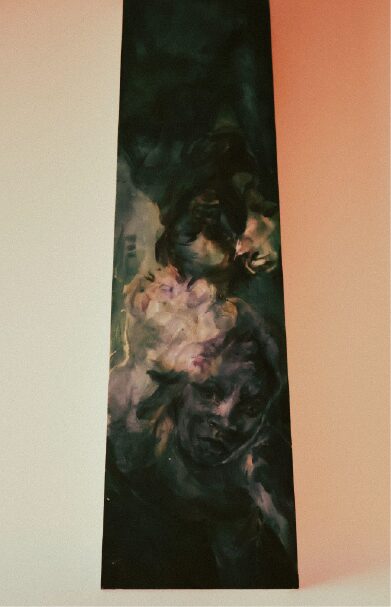
3) The painting by Daniella Toosie-Watson at the end of the essay is a response to Eve L. Ewing’s poem “The Pearl Diver,” which imagines someone diving after Eugene Williams. Knowing the context of Eugene’s story, how do you respond to this painting? Write a paragraph that details your response to the image.
Remember that the lake is ours— it belongs to us all.
Sincerely,
Samantha (your Midwestern sister from Milwaukee)
The August 2nd, 1919 edition of The Chicago Defender features an article titled “RIOT SWEEPS CHICAGO: Gun Battles and Fighting in Streets Keep the City in an Uproar; 4,000 Troops in Armory Ready to Patrol City; Scores are Killed.”1 At the beginning of the article, the unnamed journalist mentions a refusal on the part of white police officer Daniel Callahan to arrest white beachgoer George Stauber the previous Sunday for “knock[ing] Eugene Williams, age 18, 3921 Prairie Avenue, from a raft as he was floating down Lake Michigan at Twenty-ninth street.”2 This murder-by-drowning, the journalist writes, “fanned into action one of the worst race riots in the history of Illinois…Officer Callahan not only refused to make an arrest, but kept expert swimmers from reaching Williams.”3 Though it was customary to list Chicagoans’ addresses after they are mentioned by name in a Defender article, it is nevertheless striking when considering the racially segregated neighborhoods of Chicago, created by redlining, predatory loans, and other discriminatory housing practices.4 Eugene Williams’ family’s address in Northeastern Bronzeville—now a vacant lot—was just under two miles from the Twenty-Ninth Street Beach where Eugene and his friends began their Lake Michigan excursion on July 29th. As Colin Fisher notes, the “sweeping” race riot that ensued after Eugene’s murder by drowning is often primarily attributed to citywide racial tensions concerning labor, municipal politics and housing, while the violent clash at the Twenty-Ninth Street Beach is only seen as symptomatic of the former terrestrial tensions. Access to nature and recreational space—more precisely, access to recreational waters—was indeed a vital part of Black Chicagoans’ struggle for a sense of belonging and safety in the first Great Migration.5 Fisher rightly turns our attention to contested access to Lake Michigan’s waters as a “serious” significant cause of racial tension, noting the violence of extrajudicial gangs of white youth that used violent intimidation to prevent Black Chicagoans from accessing the beachfront. These violent barriers to access precedes Eugene’s death: A 1913 Defender article quotes Mrs. Joseph T. Bowen— a “prominent society woman”6 and President of the Juvenile Protection Association of Chicago— as lamenting the injustice of racial segregation on the lake. As a part of her report on “The Civil and Religious Status of the Colored People of Chicago,” Bowen states that “even the waters of Lake Michigan are not available for colored children to bathe in.”7 In a proto-Moynihanian8 tone, the same article goes on to discuss the “broken family life, surrounding of the vicious neighborhood, dearth of adequate employment, and lack of recreation for the Negro youth of both sexes[, which] can be helped only in so far as the entire colored race in Chicago is understood and fairly treated.”9 In Mrs. Bowen’s view, the terrestrial neighborhood becomes an antagonist to Black Chicagoans’ effort to thrive in the city. It is curious that Mrs. Bowen turns to the waters of Lake Michigan to introduce this need for equitable access to outdoor recreation: There is something about the lake itself, the racial violence that occurred there, and its restorative potential that demanded urgent political action. Access to aquatic recreation is part and parcel of what it means to thrive in an industrial metropolitan area, and Black Chicagoans knew and pursued it fervently. Colin Fisher and Farah Jasmine Griffin emphasize the agentive Black subjects of the Great Migration, who, as Fisher states, “on their own initiative […] used Chicago parks and beaches to temporarily escape the noise, confinement, and congestion of the South Side and make contact with the natural world.”10 Though her tone might be read as patronizing to some extent, Mrs. Bowen’s lament prompts us to turn to the realm of the aquatic as a site of racial and political contestation.
The poetry of Eve L. Ewing and photographic work of Lishan AZ also ask us to linger in the cold, murky freshwater of Lake Michigan to explore the political stakes of Black contact with the aquatic. In her collection 1919, Ewing reframes the timeline of Chicago’s Red Summer to center Eugene Williams’ engagement with the lake as the central galvanizing event of the riots. As a poet and sociologist, Ewing begins each poem with an epigraph quoted from the 1922 report from the Chicago Commission on Race Relations, entitled The Negro in Chicago: A Study of Race Relations and a Race Riot. The aim of this report was to determine the root causes of the late summer riot, and by situating quotes from this sociological report as introductions to poetic renditions and imaginings of the events of July 27th, 1919, she exposes the limits of sociology or poetry alone to tell a complete story of Black Chicagoan insurgency against white supremacy. In focusing on the events of Eugene’s interaction with Lake Michigan, I see Ewing identifying an insurgent waterscape: in this case, it is a body of freshwater that significantly shapes Black literary and historical subjectivity in the early 20th century.
As Ewing uses sociology and poetry to examine the murkiness of the conflicting reports of what exactly happened to Eugene on the raft, Lishan AZ’s Eugene’s Cove is a photographic, poetic and essayistic speculation that asks, in the words of Felicia Renaud, Africana Studies scholar of resistance and rebellion, “What if Eugene Williams did not die?”11 In her introductory essay to AZ’s collection, “All Waters are Eulogies,” she asks
What if there is a shadow image of the earth composed of clearings, covers and cafes—surreal outposts against stolen life? To find them you must become them. You must give way to the reservoir of feeling that has allowed for survival and continuity. And perhaps most importantly, you must think with the elements because they ‘unthink the world…’12
Here, Renaud introduces us to AZ’s speculative waters of Lake Michigan, where, at least between the covers of the book, Eugene might still be alive. This underwater limnological world is marked by a medley of shadows and clearings: some waters more clear, others more obscure. Renaud suggests that surrendering to the freshwater world is necessary, and in this surrender, one can become a part of the waters themselves, immersing oneself in a “reservoir of feeling” that facilitates survival in an anti-Black world. In order to imagine a Lake Michigan that provided an afterlife for Eugene, one must think with freshwater.
Each of AZ’s photographs were taken in the lake underwater on Oakwood and Rainbow beaches, both on the South Side of the city, just under 8 miles apart. The two sets of photographs in the collection are divided by age group: the first is documentary photographs of young Black Chicagoans, children who AZ met and built relationships with when she swam at the beach for exercise at the peak of the COVID-19 lockdown. During the documentation process, AZ quickly learned that the lake was the children’s “domain,” noting that “at any of the beaches on the south side, if you’re in the water, the kids control the vibe.”13 With the children, she took her camera just below the surface to ensure a relatively safer experience. The second set of photographs are full photoshoots with adults, and they called for a degree of vulnerability in the water: AZ recalls that she “was asking them to bare their bodies, they were in deeper waters, and they were actually sinking.”14 AZ photographed Black adult Chicagoans of varied swimming skill levels, and emphasized the difficulty of sinking in the cold water. She learned that “the urge that we have to breathe in actually doesn’t come from a need for oxygen, it comes from a need to expel carbon dioxide. So although we think we need to breathe in we really need to breathe out.”15 For AZ and the subjects she photographed, submersion deep underneath the surface of Lake Michigan facilitates a physical and emotional catharsis. When you slowly let the air out of your lungs, what awaits you in the cold depths of the lake? What can you invent out of the stillness underneath the waves?
I pair Eve Ewing and Lishan AZ’s texts in this essay because they both insist upon lingering in the realm of the aquatic—specifically in the material freshwater of Lake Michigan—to locate an aquatic origin for Chicago’s insurgency against white supremacist violence and to speculate on an aquatic afterlife for Eugene Williams.
Material-Metaphorical Murkiness
I use what I term limnological reading to examine the material-metaphorical contours of Lake Michigan in Ewing’s 1919 and AZ’s Eugene’s Cove. Limnology refers to the study of the physical, chemical and biological elements of freshwater systems. As a method drawn from material ecocriticism, limnological reading integrates these material elements of freshwater into close readings of literary objects.
I engage the material-metaphorical murkiness of Lake Michigan—turbidity, in limnological terms— in conjunction with the murky details of the story of Eugene Williams’ murder at Chicago’s racially segregated Twenty-Ninth Street Beach. I argue that this material and figurative murkiness allows scholar-poet Eve Ewing to speculate on who might have acted on behalf of Eugene—who might have dived in after his body, who might have taken up arms against white mob violence and police inaction? This material-metaphorical turbidity allows photographer-poet Lishan AZ to explore the liberatory potential of the cold Lake Michigan waters, as she figures Eugene as a young merman, or merchild, in her photography.
In hydrology and limnology, turbidity refers to the measure of the clarity of natural waters, specifically the extent to which sunlight passes through suspended organic matter such as clay, sediment, plankton or algae.16 Turbidity’s etymological roots are the Latin turba and the Greek tyrbe, both of which refer to a condition of “turmoil,” or “mudd[iness],” a troubled liquid “foul with extraneous matter.”17 In these roots, we see that material and figurative murkiness inform one another: a mental or emotional state of being troubled, confused or perplexed is integrated into the physical troubling of the water. Ewing engages the mystery and murky conflicting accounts of what exactly made Eugene fall off the raft and wades through the suspended sediment, the aquatic aftermath of Eugene’s death and the riots it spurred. In Lishan AZ’s physical interaction with Lake Michigan and the submersion of her film camera and her subjects, she surrenders to murkiness/turbidity in order to speculate on a potential afterlife for Eugene, as well as the restorative potential of the waters for her subjects. In an interview with her colleague and friend Nnaemeka Ekwelum, she at first laments the murkiness of the lake, but then allows it to guide her artistic vision:
The film grain played a role in texture but actually a large part of the texture was how murky the water was, which was dependent on the weather and how much algae had bloomed recently. Some days the lake was clear and some days it was murky. In the moment, I’m always blown when it’s murky, as if the shots are gonna go to waste. It happened on the day of the shoot I was most excited for, actually. The one with Marcus, with the silver fabric—I knew his was gonna go off. He just has a lot of presence […]
EMEKA: His felt choreographed.
LISHAN: Yes! Everything he does above water, underwater, he just got it. So when I arrived at the lake that day and saw the water was murky, I was blown. But then when I developed the photos, it was—
EMEKA: Stunning, stunning.
LISHAN: Yeah, it was one of those serendipitous things. The murkiness helped.18
Here, AZ works through her frustration with the unpredictability of Chicago weather and the clarity of Lake Michigan’s waters. Initially she hoped for clear waters for the highest possible level of visibility in her photographs, for if the water was too murky, the “shots would go to waste.” She looks forward to the fluid lines that one of her subjects, Marcus, will bring to their co-constructed underwater refuge. When the water that day turns out to have a high degree of turbidity, AZ learns to surrender her physical body and her artistic practice to the murkiness, allowing Marcus’ expansive wingspan and glistening silver fabric to reflect glimmers of liberatory potential. Ewing’s 1919 echoes this liberatory potential of the lake as well, but in order to arrive there, she insists upon investigating the harrowing conditions of Eugene’s murder.
Limnological reading: Ewing’s “Jump/Rope”
In the second and central section of 1919 entitled “What Happened”—a desperate question and an affirmative statement—Ewing begins her poetic investigation into the murky circumstances of Eugene’s murder. She does so by making the first voices we hear discussing Eugene’s venture into the lake those of young children playing jump rope. The epigraph of the poem “Jump/Rope” from the introduction to The Negro in Chicago: A Study on Relations and a Race Riot: “On Sunday, July 27th, 2019, there was a clash of white people and Negroes at a bathing-beach in Chicago, which resulted in the drowning of a Negro boy (x).” This epigraph reads almost clinically at first, but we see turbidity emerge even here, in the word “clash”: the collision of white mob violence against Black Chicagoans, the stirred sediment of violent racial segregation of the beach becoming visible and obscure at once. Ewing’s child speakers engage in a game of jump rope to negotiate the circumstances of Eugene’s murder. In the first two stanzas, we see a mutual recognition of childhood and a distressing warning about the perils of white gang violence:
Little Eugene Gene Gene
Sweetest I’ve seen seen seen
His mama told him him
Them white boys mean mean mean
He didn’t listen listen listen
To what mama say say say
Went to the lake lake lake
That July day day day19
Ewing’s young speaker uses the melody of “Miss Mary Mack,” a popular children’s “counting-out” game, to recount what might have occurred prior to Eugene’s 2-mile journey to the lake.20 One popular version of “Miss Mary Mack” involves the titular character asking her mother for money to go to the circus to see the elephants jump over a fence; this eagerness to venture outside the house for outdoor recreation at the circus mirrors Eugene’s childhood eagerness to visit the shores of Lake Michigan. Through the young voices of Ewing’s speakers, we see Eugene’s “sweetness,” an innocence and tenderness likely not often readily afforded to a Black 17 year old boy who labored as a Pullman Porter. We learn through these young voices that Eugene’s mother might have warned him about extrajudicial white youth gangs that frequently terrorized Black beachgoers. These “white boys” are not only rogue, loosely organized groups of white youth and young adults, but they are lifeguards, city commissioners, and police officers who prevented an urgent investigation and recovery effort for Eugene.21 This is a multi-scalar effort to hinder Black Chicagoans’ attempts at outdoor aquatic recreation.
There are multiple young speakers in this poem, and the next stanzas reveal further turbidity in the recollection of Eugene’s murder. The following stanzas begin with “no, it goes like,” signaling disagreement with and insistence upon a new understanding of Eugene’s interaction with the water:
No, it goes like
Little Eugene W
So sorry to trouble you
Rise, Eugene, rise!
Calm your mama’s cries!
Just sit up and look around
Don’t let em bury you down22
Here, another young speaker intertwines skipping rope with an urgent plea, calling on Eugene to pull himself out of the water. They express an apology for “troubling” Eugene: the action of troubling and stirring Lake Michigan while asking him to rise connoting a Christian baptism in the Jordan River. Eugene’s is a cruel baptism: it is turbid and troubling, perplexing and painful. From their place on the sidewalk, the young speaker can hear Eugene’s “Mama’s cries,” and pleads with him to not let “them” bury you down. The murky ambiguity of “them” can be productive here: “them” is the churning waves of the lake, the violent action of George Stauber and inaction of Officer Daniel Callahan, and the prevailing story of Chicago’s Red Summer that obscures its aquatic origins.
In the poem’s final stanzas, another speaker interrupts the preceding plea, lingering with the terrible material fact of Eugene’s murder by drowning:
No, it goes like
down down baby,
Down down the water’s tugging
Sweet sweet baby
Don’t let them let you go
Swallow swallow grab the sky
Swallow swallow dark
Swallow swallow grab the sky
Swallow swallow dark
Grandma grandma sick in bed
Call on Jesus cause your baby’s
No, it goes like
All dressed in black black black
All dressed in black black black
All dressed in
And he never came back back back23
This speaker emphasizes Eugene’s youth once more, affectionately referring to him as a “sweet baby.” The repetition of the lines “swallow swallow grab the sky / swallow swallow dark” call to a sense of surprise and shock that characterize the first stage of drowning: the swimmer reaches their arms high, reaching for anything to grasp onto to support their breath. The speakers are pleading with Eugene as well as describing the harrowing fact of his death: Eugene sinks into the dark murkiness of the water, and this sinking registers with his ill grandmother further inland at his Bronzeville home. There are disturbing line breaks and silences in these stanzas; where we expect to read “Grandma grandma sick in bed / call on Jesus cause your baby’s [dead]” and “All dressed in [black],” the lines are cropped to “your baby’s” and “all dressed in.” The abrupt, premature ending of these lines reflect the violent suddenness of Stauber’s murder of Eugene. The final stanza returns to the melody of “Miss Mary Mack,” where in the popular version of the rhyme, she is “all dressed in black” to go to the circus. The jovial black of Miss Mary is not the black of Eugene and his family—theirs is funeral-black, mourning-black. It is true that Eugene does not come back from this violence as he once was, but Ewing and AZ continually offer us glimmers of freedom in the material-metaphorical waters of the lake.
The glimpse of a tail and the possibility of mer-childhood
From Ewing’s careful research and rendering, we know that Eugene’s rescue was prevented from all possible angles, from the rogue white youth to the police department. AZ joins Ewing to take us into the depths of the lake, asking us to consider the possibility of Eugene’s somatic transformation. In AZ’s image, we see a Black person with their arms raised above their head, with one arm gently bent and the other extended, almost forming a halo around their head. There is light streaming into the water that illuminates certain edges of the large rocks that cover the lakebed, leaving some shrouded in darkness. The person is sinking at an angle; their body is almost touching the lakebed and their legs are not visible. Instead of kicking legs, we see peach-colored fabric billowing upward. When I look at this photograph, I see something fin-like: is this a young merman’s tail? Is this an aquatic, limnological rebirth? When I remember AZ’s insistence upon Lake Michigan as the Black child’s domain and Ewing’s insistence upon poems as speculative “what-if machines,”24 then I can allow myself to linger there, sinking, awaiting something—someone— fantastical, joyful, and alive.
Footnotes
- “RIOT SWEEPS CHICAGO: GUN BATTLES AND FIGHTING IN STREETS KEEP THE CITY IN AN UPROAR 4,000 TROOPS IN ARMORY READY TO PATROL CITY; SCORES ARE KILLED.” The Chicago Defender (Big Weekend Edition) (1905-1966), 02 Aug., 1919, pp. 1. ProQuest, https://proxy.lib.umich.edu/login?url=https://www.proquest.com/newspapers/riot-sweeps-chicago/docview/4 93562238/se-2.
- Ibid, The Chicago Defender. 2 August 1919.
- Ibid, The Chicago Defender. 2 August 1919.
- See Adrienne Brown’s The Residential is Racial: A Perceptual History of Mass Homeownership (2024).
- See Colin Fisher, “African Americans, Outdoor Recreation, and the 1919 Chicago Race Riot.” from To Love the Wind and the Rain: African Americans and Environmental History. Eds. Glave, Dianne D. and Mark Stoll. University of Pittsburgh Press, 2005.
- “MRS. BOWEN SCORES POLICE.: JUVENILE PRESIDENT DECLARES THEIR ATTITUDE TOWARD BOYS WRONG.” New York Times (1857-1922), 17 June, 1909, pp. 6. ProQuest, https://proxy.lib.umich.edu/login?url=https://www.proquest.com/newspapers/mrs-bowen-scores-police/docvi ew/96915418/se-2.
- “INJUSTICE TO NEGRO CHARGED IN REPORT: COLORED CHILDREN NOT EVEN ALLOWED TO BATHE IN LAKE MICHIGAN SAYS MRS. JOSEPH T. BOWEN IN ADDRESS.” The Chicago Defender (Big Weekend Edition) (1905-1966), 13 Dec., 1913, pp. 1. ProQuest, https://proxy.lib.umich.edu/login?url=https://www.proquest.com/newspapers/injustice-negro-charged-report/ docview/493413553/se-2.
- Here I refer to Assistant Secretary of Labor Daniel Patrick Moynihan’s 1965 report entitled The Negro Family: The Case for National Action, more commonly known as the “Moynihan report.” Written to aid the Johnson administration in its study of the origins of Black poverty in the United States, Moynihan pathologizes Black American women who are heads of their households, making the case for Black men to be given the room to “strut,” or assume a patriarchal position as the economic head of their households.
- Ibid.
- Fisher, p. 71. See also Farah Jasmine Griffin’s insistence upon the agentive Black literary subject Who Set You Flowin? The African American Migration Narrative (1995).
- Renaud, Felicia. “All Waters are Eulogies.” from Eugene’s Cove by Lishan AZ (2025). P. 4.
- Ibid, p. 4.
- AZ, Lishan. “The Making of Eugene’s Cove: A Conversation between Nnaemeka Ekwelum and Lishan AZ.” Eugene’s Cove (2025).
- Ibid, p. 109.
- Ibid, p. 108.
- Wetzel, Robert. “Light in Lakes.” from Limnology (1975). P. 62.
- “Turbidity.” Oxford English Dictionary, 3rd Edition. https://www.oed.com/dictionary/turbidity_n?tab=meaning_and_use#17488099
- AZ, Lishan. “The Making of Eugene’s Cove: A Conversation between Nnaemeka Ekwelum & Lishan AZ.” Eugene’s Cove, p. 109.
- Ewing, Eve L. “Jump/Rope.” 1919, p. 32.
- Bolton, Henry Carrington. The counting-out rhymes of children: their antiquity, origin, and wide distribution; a study in folk-lore (1888).
- See Colin Fisher, “African Americans, Outdoor Recreation, and the 1919 Race Riot.”
- Ewing, Eve L. “Jump/Rope.” p. 32.
- Ibid, p. 33.
- Ewing, Eve L. 1919.

About Samantha L. Adams
Samantha Adams is a Milwaukee native, freshwater enthusiast, and Ph.D. Candidate at the English & Women’s and Gender Studies at the University of Michigan-Ann Arbor. Her dissertation project, ‘A Body of Water Inside Me’: Insurgent Waterscapes Shaping African American Life and Literature in the Early 20th Century, indexes three forms of water beyond the Atlantic Ocean/the Middle Passage and their relationships to literary and historical Black life: the literary Lake Michigan Chicago beachfront in 1919, Floridian waters in Hurston’s Their Eyes Were Watching God, and four Black girls navigating swimming pools in Philadelphia, Harlem, and St. Augustine. She lives in the places where African American literature, Ecocriticisms, and Black Feminisms touch.
Connect
- adamssl@umich.edu
More Info
Hometown: Milwaukee, Wisconsin
Fun Fact: “I’m an identical twin!”
Influential Text on Their Work: Sula by Toni Morrison